Lewis is back on track after support from Thornbeck College
After a prolonged period out of education, a personalised plan from Thornbeck College staff has helped Lewis thrive.
In Neurodiversity Celebration Week, PETER BARRON talks to a young North East woman about her life with Tourette syndrome
Life has been challenging and painful for Claire Collinson since she started showing signs of Tourette syndrome when she was 12.
But she’s learned to cope, and built her confidence, with the help of her alter ego – Suzie.
Claire, who’s known as CC, explains:
“When people judged me because of my tics, it made me feel guilty. It felt like a personal attack on me, so I created Suzie.”
“If someone’s confused or upset by things I say, I just tell them ‘it’s Suzie, not me’,” she adds, with a smile.
Tics are involuntary movements and sounds that characterize the neurological condition, Tourette syndrome.
And CC, who lives in Newton Aycliffe, has agreed to tell her story to raise awareness of the condition.
Now 22, she’s eloquent, talented, and naturally funny, but she still needs Suzie’s help – some days more than others.
“It’s a good job we weren’t doing this yesterday – Suzie was on one!” adds CC as she chats at Thornbeck College, run by the North East Autism Society (NEAS).
It’s incredible to think that French physician and neurologist, Georges Gilles de la Tourette, first formally identified the condition in 1885, and yet it’s remained shrouded in ignorance for so long.
The acclaimed film, I Swear – based on the true-life story of John Davidson, a Scottish man with severe Tourette syndrome – is credited with raising greater awareness.
However, the controversy that ensued after John involuntarily shouted a racial slur while Black actors, Michael B. Jordan and Delroy Lindo, were on stage at the Baftas, has shown that significant gaps remain in public understanding.
That’s why CC is happy to play her part in raising awareness as part of Neurodiversity Celebration Week.
Born and raised in Scarborough, she went to mainstream schools and “everything was pretty normal” until she reached the age of 12. Suddenly, she began dropping to her knees without explanation and “making weird noises”.
“I also started pulling faces and jerking my neck but I didn’t realise I was doing it,” she recalls. “I used to walk down the corridor at school and wonder why people were pulling faces at me – until someone told me they were copying me.”
As the condition worsened, CC started shouting swear words, and her parents found it increasingly difficult to cope.
She explains:
"To be walking down the school corridor, or in a shop, and suddenly shout the f-word at the top of your lungs is obviously not nice, but it was something I had no control over."

(Above: Art by CC shows the struggle autistic and neurodivergent people can experience with masking and burnout.)
It led to bullying at school and out in the community, with one memorable incident leading to violence.
“I’m not racist or homophobic in any way but I shouted a homophobic comment to someone and it led to them punching me on the jaw,” she recalls.
It wasn’t until CC was 17 that she was finally diagnosed with Tourette syndrome.
“I didn’t want that label because it’s horrible – but once I got the diagnosis, it meant I could get help,” she admits.
For example, she was given a simple photo-identity card to show people she has Tourette’s if they are offended by her behaviour.
However, CC was still turned down by 12 other providers before NEAS offered her a place at Thornbeck College, where she’s now in her third year.
At first, she absconded, but has grown to enjoy life at the college, thanks to the support of understanding staff and a close friendship group.
From initially hating English lessons, she has gained a Level 1 qualification – a remarkable achievement given that her tics manifest themselves in random words within her written text and have to be removed when she proof-reads her work.
To help control the tics during the exam, she was given a static pedal machine as a reasonable adjustment, covering quite a distance by the time she’d finished. She’s now working towards Level 2 in maths.
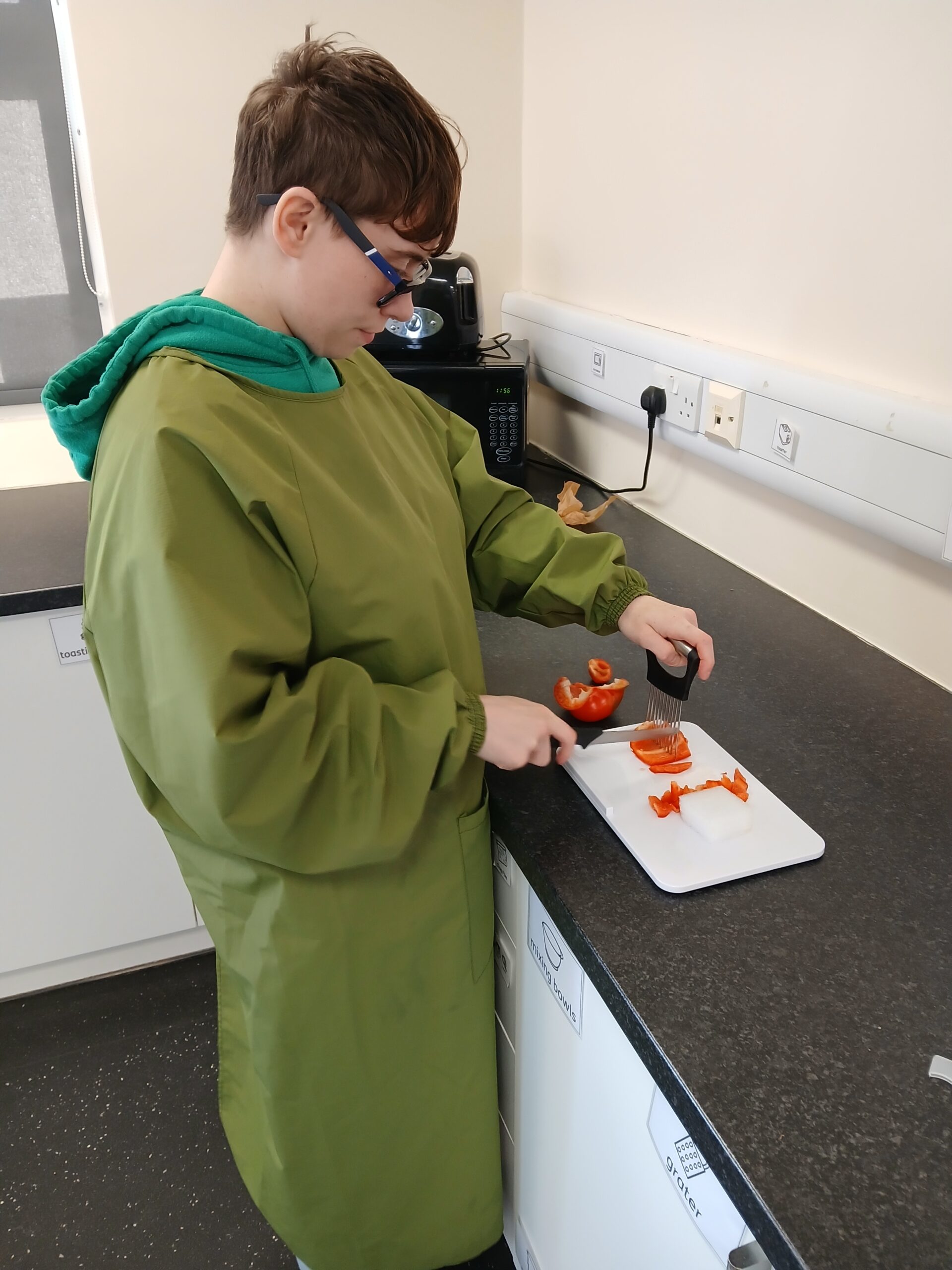
College staff have introduced a range of other ways to help her manage her tics, including adapting cooking utensils to guard against an urge to touch hot pans.
CC lives in independent, supported accommodation in Newton Aycliffe and, though her time in education ends in July, NEAS is proposing that she stays with the charity on a social care programme.
“I feel safe and happy here – what more could you want?” she says.
College principal, Fay Strong, is justifiably proud of the progress that’s been made, and says the key to improving CC’s quality of life has been trust.
“It’s been about going back to basics and helping CC realise how amazing she is and to get her to believe in herself,” adds Fay.
"All of our learners are extremely important to us – they're like family – and we've created an environment where CC feels comfortable. We might get some things wrong but we work together to make sure she gets the right support."
Challenges remain, including significant seizures, but newfound confidence has enabled her to start venturing out into the community. She goes shopping with assistance, and is able to go into quiet pubs and restaurants.
However, she stammers in anxious situations, so when she’s ordering her favourite takeaway, she wears a t-shirt bearing the words: ‘Shish kebab, salad, no sauce, please and ta.’
“I found it frustrating trying to tell them my order, but they can read the t-shirt, and I get the food, no matter what kebab shop I go into,” she explains.
Recent community visits have included a trip to the Dogs’ Trust, as well as volunteering as a bingo-caller at an old people’s home.
“I was shouting random words in amongst the numbers but they just accepted me,” she says. “If a group of old people can accept me, why can’t everyone else?”
In addition, CC has developed a talent for art, is remarkably free of tics whenever she plays the piano, enjoys motorcycling on a dirt track when she visits her parents in Scarborough, and goes on family holidays abroad.
"When I was younger, my tics could sometimes make me go mute, so I know how children feel when they can't get across what they want."
Growing up with Tourette’s has been far from easy for CC, but it’s heartwarming to see her finding her voice.
And when that voice produces words that may shock, offend or confuse, she can always blame Suzie.